I feel like I have some sort of magnet towards drug-ridden developing countries in Latin America. Ok, well maybe only two, but two that have been severely affected by the drug wars and the ensuing violence, corruption and bad image in the media.
Before I left for Mexico I listened to hundreds of warnings about how dangerous the country was, how many people take/sell/abuse drugs and how crazy I was for wanting to go to such a dangerous country. Of course these reliable sources had never been to Mexico, most likely never ever set foot in Latin America.
Those few that had been to Mexico raved about the vibrant culture, amazing food and amazing parties. These were the people I listened to.
Then, while I was still in Mexico, I told my family and friends back home I was going to live in Colombia, no less Medellin, no less work as a journalist, for two months. Again, the warnings came thick and fast, only now they were slightly easier to ignore by dumping them straight in my virtual trash can.
Now I'm not blaming my informants for what they were saying, they were simply regurgitating the most violent and shocking AP stories that filter into Australian news broadcasts. I'm not even blaming those Australian news broadcasts, they know that blood sells.
But something needs to be done. I'm writing for an English-language news site www.colombiareports.com about Colombia. The editor said that every evening he looks over the days stories and asks himself, "Is this the Colombia I know? Is this the real Colombia?
If the answer is yes, we've done our job. Of course there are almost daily murders, corruption cases against everyone from the High Court Judge to the President but there are also concerts, sporting events, great travel destinations, government initiatives, natural disasters, development and growth.
I grew to love Mexico, to understand it's darker side but to to desensitize myself from it and to semi-understand it. Now I have half the time to do the same in Colombia.
On a side note, I found two great articles recently. The first talks about the idea that Colombia's battle against drug cartels should not be copied in Mexico.
http://www.alternet.org/news/150274/colombia_is_no_model_for_mexico's_drug_war
The second is a great piece by an Australian guy in Colombia that sums up my feelings on desensitisation perfectly.
http://newmatilda.com/2011/03/10/everyday-violence
I can't wait to return to Australia and set the record straight about two of the most misrepresented, dangerous countries in the world.
Monday, March 21, 2011

Wednesday, March 16, 2011
Bienvenidos a Medellin
Loud, interested, high, aggressive, brutal, friendly, resilient.
My first impressions of Medellin, Colombia's most over-looked city. Medellin's infamous son Pablo Escobar ensured that it would be years before the city could escape from it's violent and tough past. But it seems like those years are now.
Recent redevelopment has improved livability, likability and security of the city, with honest money replacing drug money as the catalyst for change.
Libraries, metro cable cars and education programs have taken the barrios to violent, depressing human waste lands to thriving and vibrant suburbs where education is available for all. Children can once again play in the parks, women can walk the streets and locals can shop, study and play within their own environment.
But it's not all rosy and merry. Drug gangs still fight hard for their territories, with Medellin being a transit city for drug and arms shipment across the country and in and out of the Caribbean. Cocaine is still a huge trade, but for the locals, it is mostly left untouched, sent onwards and upwards. Marijuana is however widely used and abused.
The unemployment rate is sending proud men to the streets and to crime. The saying goes, no dar la papaya and nothing bad will happen. In toher words, if you get robbed it's your fault for owning something worth robbing, not the fault of the robber for seizing the opportunity.
But paisas (those from Medellin) have a reputation for resilience and resourcefulness. They've survived the war years and now they can begin to see changes, changes worth sicking around for.
Monday, March 14, 2011
The worlds most beautiful border crossing
The well-trodden backpackers route from Guatemala border hopping through Central America and looping around South America is usually travelled entirely overland by bus, train or car. However the notorious border between Panama and Colombia known as the Darien Gap is one exception. Deemed too dangerous due to Colombian narco-trafickers using it as their playground, it is a no-go zone. Rare stories of brave idiots making it out the other side alive circulate hostel common rooms and severe warnings fill guide book pages to sufficiently scare most off.
So travellers continuing on from Central to South America have been forced off land and onto the sea. A strong market has been established by private sailboat owners who offer to charter travellers for about $400-$450 with food and immigration charges included. Many do it for the extra cash, however others simply want to share their love of sailing with those willing to learn. The passage takes about five days, from Portobelo in panama to Cartagena, Colombia. While it seems quite expensiveand for most people, works out to be better deal than the $300 flight from Panama City to Cartagena.
The types of boats, their size, captains and liveability all vary, but one thing doesn’t, they all pass through the tranquil San Blas archipelago. With enough islands to visit a new one each day of the year, the San Blas islands are a sailors paradise. The majority of the islands are only inhabited by dancing palm trees, fallen coconuts and sandy shores, however some are densely populated by the indigenous Kuna people. The Kuna are an autonomous group who successfully govern themselves with minimum interference from the national government. They are proud and passionate about their traditions, believing ‘the people who lose their culture lose their soul’. The Kuna women wear traditional woven skirts and embroided blouses and a mulititude of beaded bands around their arms and legs to guard off bad spirits. They are picturesque and naturally shy, begging to be captured however those that accept photos will then ask for one dollar compensation.
Most boats leave from the quiet fisherman’s village Portobelo, a three hour bus trip from Panama City, and five days later pull into the colonial town of Cartagena, Colombia. The first three days are spent exploring San Blas islands, where you can snorkel, swim and explore. The last two days are spent crossing the open sea, with a great record for turning sun-baked backpackers into bored and barfing sailors.
Just for the record, our boat made it five days without any vomitting incidents. Our captain was proud.
The captain takes your passport in Panama and returns it in Colombia, turning this border crossing into the slowest but most beautiful you will ever experience. You could sail on a million dollar catamaran or a five-person charming sailboat, your captain could be a nomadic German sailor or a family homeschooling around the world for years.
The easiest way to get details about boats leaving is from hostels in Panama City, but be aware of a $25 commission. A new site has just started http://sanblascartagena.com/ that promises to have all the details in one easy place with a no-commission for the traveller deal. However it's not quite up and running yet. Many boats also do the return journey, but the demand is a lot less. Summer is meant to be a smoother sail, but in winter you can get lucky with the weather. Just remember to stock up on seasickness tablets before you leave.
Tuesday, March 8, 2011
The Panama Canal
I left Costa Rica via Ticabus, an overnight bus trip for about $50. Highly unsatisfied with the service, we left at 11pm, arrived at the frontera at 4:45. But the problem was that the immigration office didn't open until 6 theoretically, but 6:15am in reality.
We then spent over 4 hours at the border, waiting in line, waiting in more lines, and waiting for officials to do whatever they do. To cross the border you have to show evidence of a return ticket, which you can buy from the Tica agent for $35, but he promises you can get a refund at the office. Of course you can't, they just want your money! Many people I was travelling with managed to talk their way out of buying a ticket, maybe I was just the naive one..
Eventually we got to Panama City at almost 5pm, hot, sweaty and tired.
Panama City is a hidden gem of a city within the rest of a decaying, underdeveloped line of Central America capitals. The hype over Panama carnaval was slighty over-the-top in my eyes, sure there were parades, and there was music concerts and gospel music, but there was none of that Rio pazzazz, the boobs, bums and sequins you expect.
The more people I talk to about Panama, the more dissapointment I hear. 'Panamaniens are not lively, they give no love, they are hostile almost'. Not a great rep. And when I think about it myself, I can say that all the people I've met in Panama have not been Panamaniens. The Panamaniens aren't super friendly like their Central American counterparts, nor are they wild like their South American neighbours. Who knows why, possible due to their privedged past gaining continuous wealth from the Canal, or their recent American connection, but whatever the reason, Panama is lacking something.
The Canal was definitely the highlight. An incredible and mindblowing feat of human engineering, it is truly impressive. I was lucky to witness a giant freighter pass through when I was there, a surreal sight. The boat is lifted and dropped up to 26m above sea level by gravity, water and amazing engineering skills. These boats pay about $300,000 to pass through, and smaller yahcts around $1000. The least ever paid was 36c by Richard Haliburton in 1936 when he swam through the canal. And the best part- they have tp pay in cash 48 hours before. Bankrobbers, here's your treasure chest!
The canal will celebrate it's 100th birthday in 2014, when the new extension is set to be completed. It will be a huge celebration, bigger than Carnaval I imagine. Maybe then we'll see some real Panamenian wildness!
I'm now in Portobelo, a little fishing village near Colon on the Caribeean side. I've got a sailboat lined up to take me 5 days across the ocean to Cartagena, Colombia. Due to the fact that the overland passage between the two countries, Darien Gap, is said to be one of the most dangerous in the world, sailboat captains have tapped into this money making scheme to offer backpackers a trip of a lifetime throught the magestic San Blas Islands. The cost is about $400-$450, for 5 days sailing including food and immigration charges.
I am excited!
Thursday, March 3, 2011
Pura Vida
 Some countries get it right. Oh so right. Latest example is Costa Rica.
The daily mantra is PURA VIDA. -PURE LIFE.
But it's not just some gimmicky tourism board catch phrase to appeal to mid-life-crisis tourists, it is how Tico's live their life.
They love the sun, the sea, nature and animals. They appreciate the little bit of paradise they happen to call home and want to approvechar.
Any Costa Rican town has only 4 essentials: a school, a soccer pitch, a church, and a bar. ANythiing else is a bonus.
The wealth of beauty here impels you to be happy, to go out there and see it, feel it, breathe it, live it. Tico's want to talk to you, want to make you feel welcome here. Not in a sleazy 'hey sexy girl' Cuban style, but in their 'Hola chica, pura vida' kinda way. It's infectious. After one week here, I'm hooked. I feel the warmth of the sand and the sea run through my sunkissed skin and into my personality.
In one short week we've been woken by monkeys playing in the hotel, saw a toucan fly across a volcanic landscape, rafted class IV- V rapids, loosened our muscles in natural hot springs, surfed, hiked, swam, ate, drank, and loved every minute.
Life is pure, live it purely!

Thursday, February 24, 2011
Volcano hiking in Guatemala
The plan was to hike Santa Maria volcano in Xela at midnight under a full moon to get a glimpse down onto it's neighbour, the explosive Santiaguito volcano which is highly active. Sound too good to be true!?
It was. The night of our supposed hike, we found out it had been cancelled. Santiaguito was getting a bit too active making it too dangerous for even las chicas aventureras among us. So we settled on the well-trodden path of Pacaya in Antigua. Less dangerous, less adventurous and less unique, but actually still a great experience.
The climb was meant to take 90 minutes, we powered up in 45. The higher you go, the thicker the fog encapsulting you in the forest, making it impossible to predict your position on the mountain. We only knew we´d made it to the top when we arrived at a flat peak, completely fogged over.
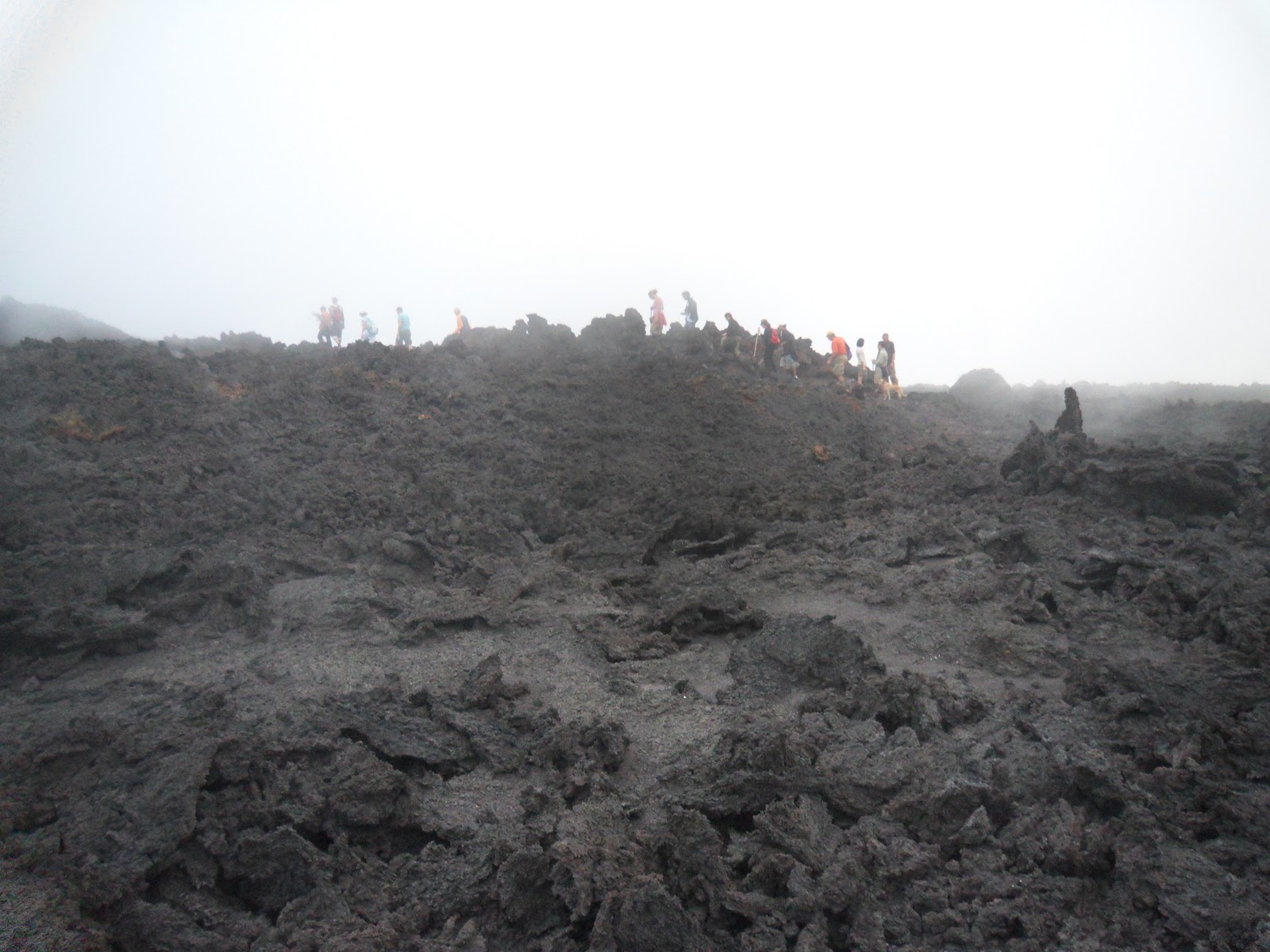
We then crossed a thick, rocky path downwards to get to the ´Sauna´. The landscape its covered in lava produced in last eruption in May 2010, which saw ash float 5km high. It is a black apocalyptical setting, completely surreal and foreign, nothing living, nothing even dead. Just us crazy hikers, daring to walk through this hot crater. We felt like we´d laned on mars, or some black, cloudy version of it. The sauna is a cave like formation, heated by natural heat expelled from the volcano. It´s steamy, two minutes leaves you breathless. It was so hot in some parts we could even cook marshmallows off the rocks.
Friday, February 18, 2011
Xela, Guatemala
 Sitting on the dusty steps outside an inconspicuous immigration office in no-mans land between Mexico and Guatemala for 6 hours is not how I imagined my first foray into Guatemala. If I'm honest I imagined something much more sinister, armed holdups, gang warfare or illegal immigrants smuggling themselves across the lengthy border.
But our hold up can be thanked to a simple economic problem of maize prices. Guatemalan farmers wanted the prices of imported Mexican maize to be lowered, so the most effective way to make the government listen is, in their opinion, by blocking the roads. The trucks stops, transport stops and bad press begins.
So we waited patiently until 6pm until the roads were opened, and made our way onward to Xela.
Quetzaltenango (or more simply Xela) has recently jumped on the relatively successful bandwagon of Spanish schools and now hosts over 20. I chose to study at El Nahual which runs the schools to help fund its volunteer project educating young children and adults who may not have access to public education.
So two weeks of 4 hour a day one-on-one Spanish lessons are now up. As are two weeks of living with a Guatemalan family and having breakfast, lunch and dinner ready and waiting for you each day and crazy afternoon with numerous under 10's who crave attention and lots of it.
I enjoyed my time here, but not sure if I would do it again. The teachers weren't the best, my first made me read a four-page article about the history of baby jesus figurines, while my second teacher taught me preterito, imperfect, futuro and condicional tenses in two days and expected me to remember them all!
I loved getting to know the kids, helping those who really wanted to learn, and sympathising with those who really struggle. In Guatemala if a child wasn't registered with the government when it was born (a surprisingly high occurance) then its a lengthy and costly process to get it into school later. A process most families can't/won't/don't do. So volunteer programs like El Nahual help to give these kids some level of education.

Our host family was comparably wealthy, the 11 year-old grandson had a laptop and plasma TV in his room, and they were in the process of adding a second story to their modest home. The food was homely and tasty. The grandmother ran the roost, along with her young Mayan maid. We ate porridge for breakfast, beans, meat and vegtables for lunch, and beans, tortillas and rice for dinner.
The long days wore me out so most nights I was sleeping before 10pm. We took a mother-daughter break with another mother and dughter duo from Belgium the middle weekend to the mesmerizing Lago de Atitlan. We stayed in the touristy Panajachel, and relaxed by the volcanous lakeside. The water was cool and refreshing. The sun was delciously soothing after the coolness of Xela. We ate well, drank well and laughed a lot.
Tomorrow I'm embarking on what I hope will be an incredible experience. I'll be hiking a live volcano, Santiaguito, at midnight, under a full moon. Can you get more magical than that.
Monday, January 31, 2011
Family holiday
Tomorrow my sister and my mum will arrive in Mexico City. I am very excited to see them, to teach them what I know and to explore with them. My sister is an experienced traveller, my mother not so. So I can expect some difficulties, stress and squabbles but most of all I expect it to bring us closer.
It's not until I realised they will be here soon that I allowed myself to realise how much I miss my family. We are close, but in a distant way. My sister and I are constantly travelling, and we haven't lived at home since we were both 18, so we are used to being apart. But at the same time we come from a kind and loving family that have always supported us. So it will be great to spend some quality time together in a new and unique environment.
We haven't been on a family holiday, the three of us, since...... I honestly can't remember. We've had weekends away with family, holidays individually or in pairs but never the three of us. So it will be great to experience a new country together.
We will all have a few days in Mexico City together before my sister goes to Cancun and will work her way through the Yucatan Peninsula by bus, while my mum and I will head to Quetznaltengo in Guatemala to volunteer in a school and learn some Spanish. Then we will all meet in Guatemala and head to Costa Rica for a relaxing week in the rainforest and the beach.
A perfect girls trip! I can't wait!
The underwater world
After Cuba I had some time to fill to await the arrival of my mum and sister so I decided to spent it underwater. That is, scuba diving.
I'd never dived before, but I'd heard only good things from friends so I decided to get my PADI open water dive certificate. I found a great company Scuba 10 in Playa del Carmen and signed up.
The most daunting thing about it is the gear. The more gear you put on, the more alien you look and feel. Big tanks on your back, hoses coming out everywhere and your whole body covered in a black wetsuit, it certainly isn't the most fashionable sport.
But once you're underwater everything changes. The first descent is incredible. as you reach the bottom and look up, it's like you really are in another world. The surface looks like the sky into another universe, and the bubbles that float from your tank slowly climb to the surface and pop away.
Over the course I did five dives, each one gaining more confidence, and spotting more things. (The first few dives you don't notice much of the amazing marine life because you are concentrating too hard on breathing, inflating, deflating, not drifting, following your instuctor and not hitting any precious coral. But after all thats ok, then you can enjoy it!)
We saw an octopus, a rare sight in the day time, and the way it changes from white to grey when it breathes. I spotted a giant lobster, a manta ray, a graceful turtle swimming all the way to the surface and back down, and a shark! It was only a nurse shark, but at the time I didn't know so I was certainly freaked when I saw it staring beadily out from a dark cave.
Being underwater is as unnatural for humans as trying to fly, so I felt priveledged to be able to interact and appreciate the diversity and beauty of the underwater world.
At least now I know once I've explored enough of the globe by land, there's a whole other world down there.
Thursday, January 20, 2011
CUBA
 CUBA
Too many clichés to describe this fascinating country. But the one I like the best, "You will fall in love with Cuba, wihtout understanding why".
It's confusing, outdated, interesting, closed, anti-capitalist, socialist, cheap, tourist-economy, loud, tasteless, daggy, sleazy and rhythmic.
My naivity before I arrived led me to believe the people would be depressed clones working a picket-line like slaves. Of course that was not like it was, nor should it be. I realised that although it is under a communist goverment, the majority of citizens still have some freedom to do as they please, especially those with money (the majority of their disposible income comes from family abroad or illegal dealings with tourists such as taxis or selling cigars).
I was travelling with a a group of 8 Australians, and with a the majority being blonde we attracted a lot of unwanted attention. Men whistled, blew kisses, called names, complemented us, followed us and continually asked us 'where are you from sexy girl?'...
We visited the towns of Havana, Trinidad, Camaguey, Santa Clara and Viñales.
 Viñales is the tobacco-heart of Cuba, This is where the large cigar factories get their tobacco leaves from. In fact, the farmers are forced to give up 80-90% of their tobacco production to these government run factories, left with only a small amount to make their own organic cigars. We visited one farmer who showed us the natural process the use, then we tasted it. The honey, rum and cinnamon flavours combined with the strong tobacco and sent us all into a happy state.
La Havana is basically broken into three sections, the renovated, tourist-friendly Havana Vieja with the museums, restaurants and art galleries. Centro is the hustle and bustle of Havana, it's loud, busy and confronting. And Vedado is the rich area, full of beautiful old colonial houses, giant hotels that were used by the mafia and tree-lined boulevards.
 Viñales is the tobacco-heart of Cuba, This is where the large cigar factories get their tobacco leaves from. In fact, the farmers are forced to give up 80-90% of their tobacco production to these government run factories, left with only a small amount to make their own organic cigars. We visited one farmer who showed us the natural process the use, then we tasted it. The honey, rum and cinnamon flavours combined with the strong tobacco and sent us all into a happy state.
Everyone knows that Cuban food is shit. I won't deny it. The 1 peso cheese pizzas, the dry and overcooked meat and the tinned spaghetti that seem to crop up on most menus certainly didn't stimulate the tastebuds, (especially after the wide variety of flavoursome Mexican dishes). However, we did discover two gems in Havana. A little authentic Chinese resturant called Tian Tan in China town served up delcious soups and noodle dishes. And Los Nardos opposite the Capitolio building was always packed thanks to its extensive menu, big servings and flavoursome Cuban fare. The pushy waiters were the only turn-off. Even the decor was rich and sensitive, as opposed to the usual plastic decor and bright lighting in the majority of government-run restaurants.
During the trip, my friends and I had the constant debate about Cubans, 'do they know what they're missing out on, or are they happy to live like this?' Of course while the government tries to limit outside influence, it is impossible to limit it all. With many Cubans living overseas, they bring foreign products, money and ideas with them when they return. Hollywood movies are shown regulary in Cuban cinemas. The internet is now available for some University students and more and more to those Cubans who have the resources to pay for it. Also the constant stream of interested tourists with comparatively full wallets must make the Cubans think twice about their rationed way-of-life. But on the other hand, they receive virtually free housing, health care and good education, some of the biggest worries and most sought after things in the capitalist economy. They have their own currency, worth a fraction of that of the toursist dollar, however the government subsidises everything from the baseball to phone lines.

One Cuban friend I spoke to wanted to know about travelling. The sensation of flying, exploring an unknown place, however his biggest worry was packing, 'How would I know what to take on holiday?'
He studies economy by day- learning about the capitalist system compared to his own socialism, and by night he tries to meet many tourists as he can (something illegal in itself without a licence) to find out about places he never thinks he will never see. A interesting contradiction.
That's how it is in Cuba.
Everyone says things are changing, slowly but surely. As more private business and foreign capital is welcomed into the economy, Cuba is slowly opening itself up to change. I left knowing I'll be back, but when, who knows.
Subscribe to:
Posts (Atom)